Unit 3: Consumption and Saving
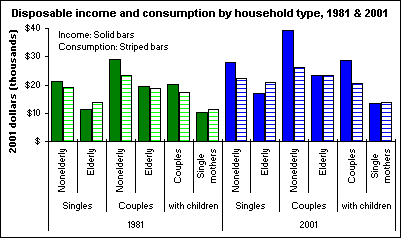
Disposable Income: income after taxes or net income
With disposable income, households can either
- Consume (spend money on goods and services)
- Save (not spend money on goods and services)
Consumption
- Household spending
- The ability to consume is constrained by (the amount of disposable income, the propensity to save)
- Do households consume of DI = 0? Yes. (autonomous consumption, dissaving)
Saving
- Household is not spending
- The ability to save is constrained by (the amount of disposable income, the propensity to consume)
- Do households save DI = 0? No.
Formulas:
APC = Average Propensity to Consume, APS = Average Propensity to Save
APC = Average Propensity to Consume, APS = Average Propensity to Save
MPC = Marginal Propensity to Consume
APC + APS = 1
1 - APC = APS
1 - APS = APC
APC > 1 = Dissaving
-APS = Dissaving
MPC + MPS = 1
MPC = 1 - MPS
MPS = 1 - MPC
MPC + MPS = 1
MPC = 1 - MPS
MPS = 1 - MPC
MPC = change in consumption/change in DI (% of every extra dollar earned that is spent)
- the fraction of any change in disposable income that is consumed
MPS = change in savings/change in DI
- the fraction of any change in disposable income that is saved


Comments
Post a Comment