Unit 2: GDP
- i.e an American working within the US is on the US' GDP
- formula: GDP = C + Ig + G + Xn (expenditure approach)
- C: personal consumption expenditure - finished durable and non-durable goods (67% of the economy)
- Ig: gross private domestic investment - new factory equipment, factory equipment maintenance, construction of housing, unsold inventory of products built in a year (net private domestic investment + depreciation)
- G: government spending
- Xn: net exports - (Exports - Imports)
Not Included in GDP:
- used or secondhand goods (in an effort to avoid double counting)
- gifts; transfer payments: no output is produced, recipients contribute nothing to current production (public: welfare, social security; private: scholarships)
- stocks and bonds (purely financial transactions)
- unreported business activities (tips)
- illegal activities (drugs, prostitution, etc)
- intermediate goods: goods that require further processing before they are ready for final use
- nonmarket activity: (volunteer work or family work)

--------------------------------------------------------------------------------------------------------------------------
Included or Exluded in GDP Practice:
1. $10 for movie tickets: GDP (C)
2. $5M increase in defense expenditures: GDP (G)
3. $45 for used economics textbooks: Excluded (Secondhand)
4. Ford makes a new $2 million factory: GDP (Ig)
5. $20K Toyota made in Mexico: Excluded (Imports)
6. $10k Profit from selling stocks: Excluded (stocks and bonds)
7. $15K car made in US and sold to Canada: GDP (Xn)
--------------------------------------------------------------------------------------------------------------------------
Expenditure vs. Income Approach to GDP
Expenditure Approach: add up all the spending on final goods and services produced in a given year
- Formula: C + Ig + G + Xn
Income Approach: add up all the income that resulted from selling all final goods and services produced in a given year
- Formula: WRIP + Statistical Adjustments
- W - wags (salary, salary supplements, compensation of employees)
- R - rent (rental income)
- I - interests (interests income)
- P - profits (proprietor's income)
Expenditure Approach is based on receipts. Income Approach is based on verbalization. Whatever you get for the expenditure approach must equal the income approach.
- Expenditure Approach: GDP + net foreign factor payment
- Income Approach: WRIP
- i.e. an American working in Dubai would be on Dubai's GNP
--------------------------------------------------------------------------------------------------------------------------
Formulas
- Exports - Imports
- If it is positive it is a surplus, if it is negative it is a deficit
Budget:
- government purchases of goods and services + government transfer payments - government tax and fees collection
- If it is positive it is a deficit, if it is negative it is a surplus
National Income:
- Option 1: compensation of employees + rental income + proprietor's income + corporate profits
- Option 2: GDP - indirect business Taxes - depreciation - net foreign factor payment
Disposable Personal Income:
- national income - personal household taxes + government transfer payments
Net Domestic Product:
- GDP - depreciation
Net National Product:
- GNP - depreciation
Nominal GDP: the value of output (quantity) produced at current year prices.
- current output at current prices
- P x Q
- can increase from year to year if either output or price increase
Real GDP: the value of output produced in constant base year prices that is adjusted for inflation.
- constant output at base year prices
- P x Q
- can increase from year to year only if output increases
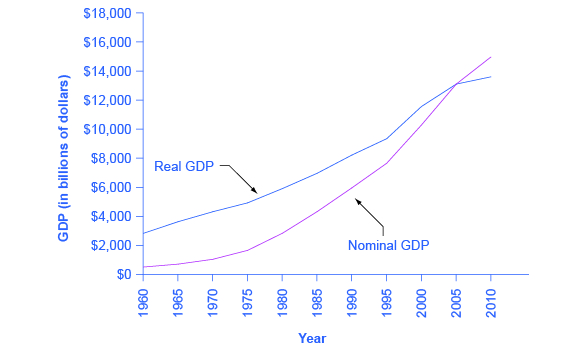
In the base year, nominal GDP will be equal to real GDP. In years before the base year, real GDP will exceed nominal GDP. In years after the base year, nominal GDP will exceed real GDP.
GDP Deflator: a price index used to adjust from nominal to real GDP
- (nominal GDP/real GDP) x 100
In the base year, GDP Deflator will equal 100. For years before the base year, GDP deflator is less than 100. For years after the base year, GDP deflator is greater than 100.
Inflation: A rise in the general level of prices.
Inflation: A rise in the general level of prices.
- (New Price Index - Old Price Index/Old Price Index) x 100
Consumer Price Index (CPI): measures the cost of the market basket of goods of a typical urban American family.
- (Cost of a market basket of goods in a given year/Cost of a market basket of goods in the base year) x 100


Very accurate and organized notes! I love the use of the GDP graph to show how nominal and real GDP differ. However, don't forget that there is no output being produced for stocks & bonds as well, not just for gifts & transfer payments. In addition, I recommend that you include the fact that 'depreciation' may also be referred to as 'consumption of fixed capital' at times, in order to further help the reader understand all of the terms.
ReplyDeleteThe GDP is the best measure of the economy of a country.
ReplyDeleteIn addition, the natural rate of GDP is 2-3%
ReplyDelete